Es mostren els missatges amb l'etiqueta de comentaris historical places. Mostrar tots els missatges

Malbork Castle


Malbork Castle

The Castle in Malbork (German: Marienburg, Polish: Zamek w Malborku) was built in Prussia by the Teutonic Order, a German Roman Catholic religious order, as an Ordensburg (fortified castle of the order). The Order named it Marienburg (Mary's Castle). The town which grew around it was also named Marienburg. Since 1945, when it became part of the nation of Poland after World War II, it has been called Malbork. The castle is a classic example of a medieval fortress, and on its completion in 1406 was the world’s largest brick Gothic castle. UNESCO designated the "Castle of the Teutonic Order in Malbork" and its museum as World Heritage Sites in December 1997. It is one of two World Heritage Sites in the region with origins in the Teutonic Order. The other is the "Medieval Town of Toruń", founded in 1231 as the site of the castle Thorn (Toruń).

Medieval Times:
The castle was founded in 1274 by the Teutonic Order during its rule of Prussia. It is located on the southeastern bank of the river Nogat. It was named Marienburg after the Virgin Mary, patron saint of the Order. The Order had been based in Acre (present-day Israel). When this last stronghold of the western Crusades fell to Muslim Arabs, the Order moved its headquarters to Venice. In 1309, in the wake of the papal persecution of the Knights Templar and the Teutonic takeover of Danzig, Siegfried von Feuchtwangen led the Order to relocate its headquarters into the Prussian part of its monastic state. They chose the site of Marienburg, conveniently located on the Nogat in the Vistula Delta. As with most cities of the time, it was based on water for transportation. The castle was expanded several times to house the growing number of Knights. It became what some claim is the largest fortified Gothic building in Europe. It has several subdivisions and numerous layers of defensive walls. It consists of three separate castles - the High, Middle and Lower Castles, separated by multiple dry moats and towers. The castle once housed approximately 3,000 "brothers in arms". The outermost castle walls enclose 52 acres (21 ha), four times the acreage of the enclosed space of Windsor Castle. The developed part of the property designated as a World Heritage Site is 18.0380 ha. The favourable position of the castle on the river Nogat allowed for easy access by barges and trading ships arriving from the Vistula and the Baltic Sea. During their governance, the Teutonic Knights collected river tolls from passing ships, as did other castles along the rivers. They controlled a monopoly on the trade of amber. When the city became a member of the Hanseatic League, many Hanseatic meetings were held at Marienburg castle.
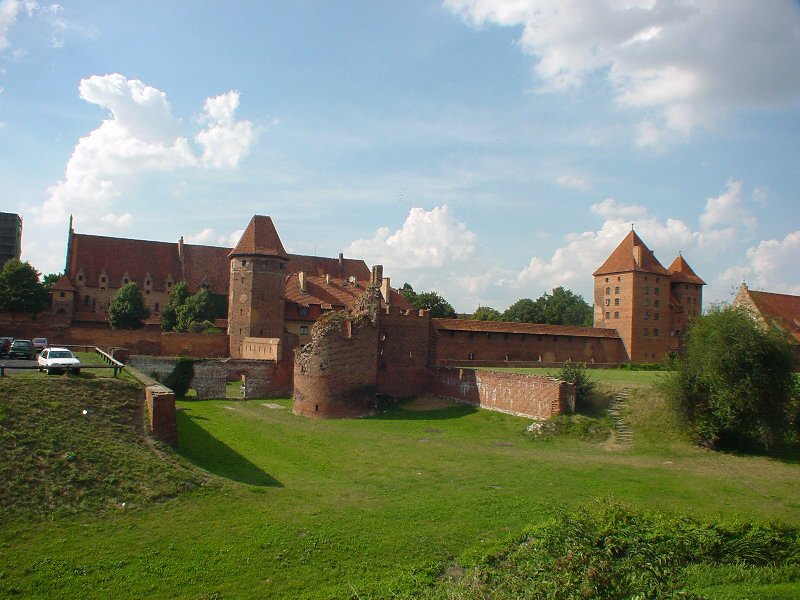
In the summer of 1410, the castle was besieged following defeat by the armies of Władysław II Jagiełło and Vytautas the Great (Witold) at the Battle of Grunwald. Heinrich von Plauen successfully led the defense in the Siege of Marienburg (1410), during which the city outside was razed. In 1456, during the Thirteen Years' War, the Order—deserted and opposed for establishing taxes to pay high ransoms for prisoners taken by the Polish king—could not pay its mercenaries. Hochmeister Ludwig von Erlichshausen moved the seat of the Order to Königsberg. Stibor de Poniec of the Clan of Ostoja raised funds from Gdansk for a new campaign against the Order. Learning that the Order's Bohemian mercenaries had not been paid, Stibor convinced them to leave by promising them their unpaid wages. He used the money from Gdansk to pay them. Following the departure of the mercenaries, King Casimir IV Jagiellon entered the castle in triumph in 1457.


Under mayor Bartholomäus Blume, the city resisted the Polish forces for three more years, but the Poles captured and hanged him in 1460. A monument to Blume was erected in 1864. In 1466 both castle and town became part of Royal Prussia. It served as one of the several Polish royal residences. During the Thirty Years' War, in 1626 and 1629 Swedish forces occupied the castle. They invaded and occupied it again 1656 to 1660 during the Northern Wars.

Modern Times:
After Prussia and the Russian Empire made the First Partition of Poland in 1772, the town became part of the Kingdom of Prussia province of West Prussia. At that time, the officials used the rather neglected castle as a poorhouse and barracks for the Prussian Army. In 1794 David Gilly, a Prussian architect and head of the Oberbaudepartement, made a structural survey of the castle, to decide about its future use or demolition. Gilly's son, Friedrich Gilly, produced several engravings of the castle and its architecture, which he exhibited in Berlin and had published by Friedrich Frick from 1799 to 1803. These engravings led the Prussian public to "rediscover" the castle and the history of the Teutonic Knights.  Johann Dominicus Fiorillo published another edition of the engravings on 12 February 1803, also wanting to encourage public interest. Max von Schenkendorf critizised the defacement of the castle. Throughout the Napoleonic period, the army used the castle as a hospital and arsenal. After Prussia was liberated again, the castle became a symbol of Prussian history and national consciousness. Initiated by Theodor von Schön, Oberpräsident of West Prussia, in 1816, restoration of the castle was begun. It was undertaken in stages until World War II started. 

With the rise of Adolf Hitler to power in the early 1930s, the Nazis used the castle as a destination for annual pilgrimages of both the Hitler Youth and the League of German Girls. The Teutonic Castle at Marienburg served as the blueprint for the Order Castles of the Third Reich built under Hitler's reign.  In 1945 during World War II combat in the area, more than half the castle was destroyed. At the conclusion of the war, the city of Marienburg and castle became part of Poland. A fire in 1959 caused further damage. The castle has been mostly reconstructed, with restoration ongoing since 1962. The main cathedral in the castle, fully restored just before WWII, is still in ruins.

Jasna Góra


Jasna Góra

The Jasna Góra Monastery (Polish: Jasna Góra, English: Luminous Mount, Hungarian: Fényes Hegy, Latin: Clarus Mons) in Częstochowa, Poland is the most famous shrine to the Virgin Mary in Poland and the country's greatest place of pilgrimage - for many its spiritual capital. The image of Black Madonna of Częstochowa, to which miraculous powers are attributed, is Jasna Góra's most precious treasure. Founded in 1382 by Pauline monks who came from Hungary at the invitation of Władysław, Duke of Opole. The monastery has been a pilgrimage destination for hundreds of years, and it contains the most important icon of the Virgin Mary in this part of Europe. The icon, depicting the Mother of God with the Christ Child, is known as the Black Madonna of Częstochowa or Our Lady of Częstochowa, which is widely venerated and credited with many miracles. Among these, it is credited with miraculously saving the Jasna Góra monastery during a siege that took place at the time of The Deluge, a 17th century Swedish invasion. Although this event was of little military importance, the event stimulated the Polish resistance. The Poles could not immediately change the course of the war but after an alliance with the Crimean Khanate they repulsed the Swedes. Shortly thereafter, in the cathedral of Lwów, on April 1, 1656, Jan Kazimierz, the King of Poland, solemnly pronounced his vow to consecrate the country to the protection of the Mother of God and proclaimed Her the Patron and Queen of the lands in his kingdom.

Wilanów Palace

 Wilanów Palace

Wilanów Palace (Polish: Pałac w Wilanowie, is a royal palace located in the Wilanów district, Warsaw. Wilanów Palace survived the time of Poland's partitions and both World Wars and has preserved its authentic historical qualities, also is one of the most important monuments of Polish culture. The palace and park in Wilanów is not only a priceless testimony to the splendour of Poland in the past, but also a place for cultural events and concerts, including Summer Royal Concerts in the Rose Garden and the International Summer Old Music Academy. Since 2006, the palace is a member of the international association of European Royal Residences.

History:
Wilanów Palace was built for the Polish king John III Sobieski in the last quarter of the 17th century and later was enlarged by other owners. It represents the characteristic type of baroque suburban residence built entre cour et jardin (between the entrance court and the garden). Its architecture is original - a merger of European art with old Polish building traditions. Upon its elevations and in the palace interiors antique symbols glorify the Sobieski family, especially the military triumphs of the king. After the death of John III Sobieski in 1696, the palace was owned by his sons and later by the famous magnate families Sieniawskis, Czartoryskis, Lubomirskis, Potockis and Branicki family of the Korczak coat of arms. In 1720, the property was purchased by Polish stateswoman Elżbieta Sieniawska who enlarged the palace. Between 1730 and 1733 it was a residence of Augustus II the Strong, also a king of Poland (the palace was exchanged with him for the Blue Palace at Senatorska Street), and after his death the property came to Sieniawska's daughter Maria Zofia Czartoryska. Every owner changed the interiors of the palace, as well as the gardens and grounds, according to the current fashion and needs. In 1778 the estate was inherited by Izabela Lubomirska, called The Blue Marquise. She refurbished some of the interiors in the neoclassical style between 1792–1793 and build a corps de gardes, a kitchen building and a bathroom building under the supervision of Szymon Bogumił Zug.
In the year 1805 the owner Stanisław Kostka Potocki made a museum in a part of the palace, one of the first public museums in Poland. Besides European and Oriental art, the central part of the palace displayed a commemoration of king John III Sobieski and the glorious national past. The palace was damaged by Germans forces in World War II, but it was not demolished after the 1944 Warsaw Uprising. After the war, the palace was renovated, and most of the collection stolen by Germany was repatriated. In 1962 it was reopened to the public.

Wawel royal castle

Wawel Royal Castel

Wawel is an architectural complex erected over many centuries atop a limestone outcrop on the left bank of the Vistula River in Kraków, Poland, at an altitude of 228 metres above the sea level. It is a place of great significance to the Polish people. The Royal Castle with an armoury and the Cathedral are situated on the hill. Polish Royalty and many distinguished Poles are interred in the Wawel Cathedral. Royal coronations took place there also. Wawel began to play the role of a centre of political power at the end of the first millennium A.D. In the 9th century it became the principal fortified castrum of the Vistulans tribe (Polish: Wiślanie). The first historical ruler Mieszko I of Poland (c.965-992) of the Piast dynasty as well as his successors: Boleslaw I the Brave (Polish: Bolesław I Chrobry; 992-1025) and Mieszko II (1025–1034) chose Wawel as one of their residences. At that time Wawel became one of the Polish main centres of Christianity. The first early Romanesque buildings were erected there including a stone cathedral serving the bishopric of Kraków in the year 1000. Since the reign of Casimir the Restorer (1034–1058) Wawel became the leading political and administrative centre for the Polish State.

Wawel hill:

Wawel hill has the form of a horst that originated in the Miocene epoch (23-5 million years ago). It is made up of Jurassic limestone dating back to the Oxfordian age (161-155 million years ago). The limestone is strongly karsted and abounds in caves (e.g. the Dragon’s Den - Smocza Jama). This could explain why the hill was originally called "wąwel", meaning ravine in Polish. Once the ravine divided the hill in two. According to another theory this word means 'protrusion from the marshes' which surrounded the hill. According to the newest theory name "Wawel" is a regular continuation of the name Babel in both Greek and Old Church Slavonic languages  The hill is the site of a group of historic buildings, including Wawel Castle and the Wawel Cathedral (the Cathedral Basilica of St. Stanisław and St. Wacław). The complex also comprises the Wawel Hill Fortifications. The remains of other buildings, dating back to different historical periods, have also been found on the site.

The history of medieval Wawel is deeply intertwined with the history of the Polish lands and Polish royal dynasties during the Middle Ages. The political and dynastic tensions that led to the ascendence of Kraków as the royal seat are complex, but for most of the Middle Ages and the Renaissance Wawel was the seat of the national government. As the Polish-Lithuanian Commonwealth formed and grew, Wawel became the seat of one of Europe's most important states. This status was only lost when the capital was moved to Warsaw in the 17th century. Beginning in the second half of the 18th century, when Poland lost its independence during the period of partitions, Wawel became a symbol of the enduring nation and wittnessed demonstrations and gatherings of Cracovians against the foreign occupation. The significance of the Wawel Hill comes in part from its combination of political and religious structures and their functions. The Cathedral holds the relics of St. Stanisław and stands directly adjacent to the Royal Castle. The Hill has long served religious functions; some of the oldest extant architectural remains are those of the Rotunda of the Virgin Mary, which may be visited today in a tour that takes visitors into the walls and foundations of the present-day buildings. The history of Wawel is long and complex. Throughout the centuries Wawel has undergone many changes that are presented below.

Legeng of The Wawel Dragon:

Smok Wawelski, also known as The Dragon of Wawel Hill or simply The Wawel Dragon, is a famous dragon in Polish folklore. He laired in a cave under the Wawel Hill on the banks of the Vistula river, although some legends place him in the Wawel mountains. In some stories the dragon lived before the founding of the city, when the area was inhabited by farmers.The Wawel Cathedral features a statue of the Wawel Dragon and a plaque commemorating his defeat by Krakus, a Polish prince who, according to the plaque, founded the city and his palace on the slain dragon's lair. The dragon's cave under the castle is now a popular tourist stop. 
A popular version of the Wawel Dragon tale takes place in Kraków during the reign of king Krakus, the city's legendary founder. Each day the evil dragon would beat a path of destruction across the countryside, killing people, pillaging their homes and devouring their livestock. In many versions of this story, the dragon especially enjoyed eating young girls, and could only be appeased if the townfolk would leave a young girl in front of his cave once a month. The King certainly wanted to put a stop to that awful situation, but his bravest knights fell to the dragon's fiery breath. In the versions involving the sacrifice of young girls, every girl in the city was eventually sacrificed except one, the King's daughter Wanda. In desperation, the King promised his beautiful daughter's hand in marriage to anybody who could defeat the dragon. Great warriors from near and far fought for the prize and failed. One day, a poor cobbler's apprentice named Dratewka accepted the challenge. He stuffed a lamb with sulphur and set it outside the dragon's cave. The dragon ate it and soon became incredibly thirsty. No amount of water could quell his stomach ache, and after swelling up from drinking half of the Vistula river, he exploded. The apprentice married the King's daughter as promised and they lived happily ever after.